Wednesday, March 7, 2012

EIGHT EIGHT EIGHT (8)

http://www.youtube.com/watch?v=fPhse4WlgEA

Toy Story Trailer..


I realize this is a trailer, but I found it similar to a scene as it is made up of scenes. The idea I get is this film is targeted towards families, a movie Mom and Dad would take everyone too after going out for pizza. That theme is incredibly active – from the toys playing when people aren’t there (something about people’s imagination leaves them after they are 10, so this is obviously for the 10 and under), to the toys talking and the children’s birthday party. This theme is throughout, all the way to the end with the toy solider and the dog chasing the toys. Dog = family.


The rhythm of the trailer is very typical – it stays exciting and engaging enough to make you thirst to see more. The two minutes are supposed to make you want to view the two-hour version. The way it cuts from scene to scene, revealing enough plot info to awaken your interest but not enough for you to really understand what is going on. The tough part with a trailer is keeping it interesting throughout – they do a good job, and the rhythm of it is a big part of that. There are no ‘slow’ parts per se, which is critical. Consciously the film would (I assume) put a parent in a position where they might think “I’ll take my kids to that!” whereas subconsciously it might remind them of the innocence of childhood, hopefully their own childhood. The movement is mostly quick moving, short scenes, quick bits here and there – all very short, sweet and to the point. They leave you wanting more.

I especially like the overhead shot of the room in the beginning – you get an idea of a major ‘set’ in the movie if you will, they spend a lot of time there. When the shots aren’t close ups of Woody or Buzz, there is a lot of space in the shots. For example when they show the other toys, or the house, things like that. Otherwise all the focus is on Woody and Buzz – the main characters, again it is very logical and thought-out. The makers of the film intended it to be this way it wasn’t on accident. In conclusion, obviously the movie is considered one of the greatest of all time. I really enjoyed the trailer though, it made me want to see the movie again and analyzing it taught me a lot. Thank you!
 

blog SEVEN (#7)


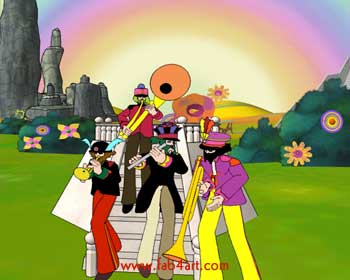
Well, both of these pictures are from The Beatles’ movie “Yellow Submarine.” It was an animated film voiced by actors and released in 1968. I’ll start by discussing their movement. In the top picture the movement is definitely horizontal. If you see the film, the characters move in all directions but the ‘sea of holes’ is constantly forcing your eyes in a horizontal direction. The bottom picture on the other hand had us looking vertically up at the band (as helped with the rail thing, putting a vertical line there.) The bottom picture is also helped vertically as we can see all we need to in the center of the image – everything else is background, putting it at the forefront.

In terms of color the bottom one is obviously upbeat, happy, colorful. It’s very bright, and that helps to create a mood throughout those scenes. The top on the other hand is plain – that goofy looking character is called the “Nowhere Man” (after The Beatles song). He lives in a ‘sea of holes’ and is a nowhere man. So the plain black and white background gives us that feeling and knowledge – before the characters even speak, we know he is simple - black and white.

Lighting is similar to color – the bottom picture is very bright, very happy. The lighting gives us that feeling of joy, and the rainbow helps to pronounce the band in the front. To highlight them - it’s all thought out. The top one on the other hand is very plain – but this plain lighting also helps to highlight the band, as they are in color. So both pictures using totally different methods accomplish the same thing. For symbolism I’d say the bottom one symbolizes something good – that’s what I get out of the picture. The top one isn’t bad, or even negative, it’s just plain – which I am sure was their intention in making it. In fact in putting them on a plain background it shows their true colors (literally) and so it really makes our main characters look great for what they are, as there are no distractions in the background. Very cool, I hope you enjoyed reading it!

Tuesday, March 6, 2012

blog 6 (six)


38 seconds shot..i'm sorry these drawing aren't the most wonderful thing to look at, i am insanely bad at this, hopefully my writing makes up for my art failure. thanks!
Overhead - the circles are the people, the messy thing is the fire, behind them is a Native American TP type of thing.


At 22 seconds the rule of thirds is used, the rule of thirds is used at every shot it seems and the 180 degree rule is not used as the camera stay in essentially the same position the entire time changing only it’s focus. The 30-degree rule is used as the camera shifts to focus on different characters – this is beneficial as they are all around a campfire. It was obvious to the maker’s of the film that the rule would work and improve their movie. The rule of thirds is practically always used, whether it is their cowboy hat(s) and beans that are at a point or intersection or a face. The shots are never boring, which is required of any serious film. This can be seen especially in any one of the last three shots: 31, 38 and 46 seconds. In fact the character’s heads are practically perfectly aligned with the rule of thirds lines.

In conclusion, I wouldn’t exactly say the director broke any rules; rather they found what would work for their artist vision and used what they needed to make what they wanted. They used the rules; the rules didn’t use them. I think that’s important to keep in mind – the rules are tools you can use to make your art. But if you strictly follow the rules, what you get probably won’t be too interesting. You have to get creative within the boundaries. The top people at a given field are at the top because they played within the rules but did something different. That is what I found here and I think that’s very important, in my view (no pun intended!). A great scene from a great movie, I hope you liked it (again I’m sorry about my drawing ability, the scenes took me forever!).
 

Wednesday, February 29, 2012

blog#5 (cinco)

http://www.youtube.com/watch?v=swuWRQhzE0A

I Just Want To Make Love To You - The Rolling Stones version (written by Willie Dixon)

LISTENING FRAMEWORK
(SIMPLIFIED)
LISTENING PHASE 1 (Rhythm) Tempo [slow, medium, fast]

It's sort of in between. It's a medium tempo rocker, kind of up beat.


Source [where is the rhythm coming from?] 
The Bass, drums and guitar of course. People tend to think rhythm section as bass and drums, which is true but the guitar is also keeping the rhythm, especially in this.


Groove [describe how the personality of the rhythm] 
It's a blues song played uptempo, rock style. Pretty standard, what Elvis and the others all did. Very good.


LISTENING PHASE 2 (Arrangement) Instrumentation [which instruments drive the song?] 
The guitar lick definitely drives, the drums do too especially when it picks up after the solo. The harmonica also drives it a bit.


Structure/Organization [how is the song built? Order, patterns, etc.] 
Verse, Chorus, stop thing, verse, chorus, 'love to you, sweet love to you', drum bit, end.
This is live video is shortened from the studio version which has a short break, a harmonica solo and a guitar solo.


Emotional Architecture [Draw how the song build and drop?] 
It's pretty standard in build - the verses describe what the chorus is all about. It's all about sex, a down and dirty blues song made rock and roll.


LISTENING PHASE 3 (Sound Quality) Balance
  • -  Height [high and low of frequency] 
  • Since it's a sixties recording it doesn't have the depth sound-wise a recording today would, but on the low we have bass and bass drum, middle to high is guitar and vocals, high is guitar and harmonica.

  • -  Width [stereo panning left/right] 
  • The studio version is mono I believe, very 'old school' as they say.

  • -  Depth [layers of instruments - via loudness] 
     It's essentially a garage band, so the layers aren't there compared to say "Wild Horses" where there is acoustic guitar and piano and such. This is just an early rocker - not as much depth.
  •  
  •  
  •  
  •  
  •  
  • http://www.youtube.com/watch?v=KUgvVAFFzN8

  • I Just Want To Make Love To You - Etta James version

    LISTENING FRAMEWORK

    (SIMPLIFIED)
    LISTENING PHASE 1 (Rhythm) Tempo [slow, medium, fast] 
    Sort of 'march' like, it drags. Medium tempo.


    Source [where is the rhythm coming from?] 
    The Drums, but the bass and horns and such play an important part too.


    Groove [describe how the personality of the rhythm] 
    The groove is pretty standard, it's essentially what was played on every Motown song in the early to mid sixties, a bit slower.

    LISTENING PHASE 2 (Arrangement) Instrumentation [which instruments drive the song?] 
    The Strings, horns, bass, etc. Especially the drums and horns.

    Structure/Organization [how is the song built? Order, patterns, etc.] 
    Typically verse/chorus song.

    Emotional Architecture [Draw how the song build and drop?] 
    It builds a bit for the chorus - which is standard. Her voice is unmatched - she's a legend, and when she let's rip, you feel it. That's what sets Etta James, and any good musician apart from the rest. Feeling.

    LISTENING PHASE 3 (Sound Quality) Balance
    • -  Height [high and low of frequency] 
    High would be her voice (at times - vocals are always in the upper middle level frequency-wise). The horns, and strings are definitely in the higher end, especially strings. Holding it down on the low end we have bass and drums.

    • -  Width [stereo panning left/right] 
    • Her voice is dead center. This sounds like it's mono - it ain't Dark Side of The Moon, or Sgt. Pepper, but that's fine. Very straight ahead.

    • -  Depth [layers of instruments - via loudness]
    • We have horns on top, especially when they're alone - as soon as she sings, she's the loudest. Bass and drums are always in the back a bit, but that's their job.


    In terms of lyrics, obviously they are the same as it’s the same song. Although in Etta’s version you can much more clearly hear her singings about how she loves this man – “I don’t want to see you sad and blue, I just want to make love to you” and you can tell she means it. Meanwhile the Rolling Stones version, being a bit more rock and roll, sounds more like Mick Jagger really wants to make some girl. The point that gets across more is that he really wants to make love to her. Especially the way they emphases the chorus, with that little speed up. It’s true to the original version by Muddy Waters, though, and what comes across is that the Stones really liked blues and rock and roll in their early days.


    The melody is great, pretty standard of blues. In the Rolling Stones version, the repeating guitar lick is VERY Chuck Berry, which makes sense as he is Keith Richards’ idol. The melody for Etta’s is very much in her voice, the strings and the horn arrangement. Let’s not forget that piano though – the piano in her version is helping with the melody, and putting forth an interesting rhythm – and it builds when the drums and such do.  Also, the saxophone solo in her version – I’m surprised this is my first time mentioning it. For Etta’s version, we have a lot of intensity, definitely more so then the Stones version; hers is more dynamic. There is more to the organization of hers as well – in terms of arrangement, organization, and instrumentation. But that’s the point; they’re both playing the same song, but getting a totally different message across – the Stones are rock and roll, sloppy, simple and energetic – it doesn’t make one more talented or better then the other. They are just simply different, and I love both. Interestingly enough the label that put out Etta’s version, Chess records, was a favorite of the Rolling Stones. Their cover is of Muddy Waters’ earlier version. The Rolling Stones later recorded at Chess records in Chicago and Etta James opened for them on tour in 1978.


    Sunday, January 29, 2012

    Blog 4


    (FART) BZZZZ (repeat, as multiple characters fart – this continues for approx. one minute)
    Character 1
    How about some more beans, Mr. Taggert”
    Character 2
    “I’d say you’ve had enough.”


    Listening modes: these are all casual sounds as they are literal farts/fart sounds. It’s non-diegetic, you can see and hear them fart, and so can they, but it’s not like a car crash where you actually see the act happening. The size, distance and perception are all there. As the camera moves across each character, they all fart and this is reflected visually and audio-wise. It’s all there, very well done – professional. The similarity is there – no fart sticks out, because that would be weird. It’s a very basic scene, but it’s pretty legendary. Perhaps a better scene to analyze would be in the beginning of “Blazing Saddles” when the two black characters ride down the handrail cart on the train track. As the cart moves, so does the camera and sound – it is executed in a professional way as to make us feel like we are a part of it. When their cart hits quicksand and begins to sink – the sound reflects that. (I’ll include a link to that scene, as I’ve mentioned it quite a bit. Here it is, sort of - http://www.youtube.com/watch?v=L7QF32mxftE).

    blog #3

    http://changethis.com/manifesto/show/66.01.Brainwashed


    (it said this should be 150 words total, I didn't know if that meant for each category or all of them together..anyway these three together are 260 some words. I took out about 50. I hope this is alright!! Thank you so much..)

    LIZARD
    Ah, the lizard. An interesting name for it; the fear of failure, the fear of being laughed at. In my experience as a musician, my first fear was of getting on stage and playing – will they laugh? Will I mess up? And those are very real fears, but I think what’s more important is the bigger picture. In the bigger picture many are afraid, not just of acting or performing, or being laughed at, but the bigger fear is in actually pursuing something in the arts. You may be afraid of being laughed at in the high school play, but you get over that. The bigger fear is: how do I tell my parents, friends and so forth that I want to try and make a career of it? Try and make something from nothing, which is essentially what creativity is in a nutshell.

    MAKE ART
    How refreshing!!! Literally, for the first time in my entire public education I am being told to create. I’ve spent my entire 19 years (1/5 of my life!!!) being told to “solve,” solve what? A question, which already has an answer? Sounds like a waste of time to me…  I love this. Art is absolutely the opposite of trigonometry. It’s you, being yourself. Creativity is abnormal; you’re forced to react, not create things that get reactions.

    LEARN
    I love it. Great point. It’s how I’ve felt my whole life; “don’t let school get in the way of your education.” I haven’t, I’ve learned so much more, my entire life on my own then I have even gotten close to learning in school. 


    Blog Talk
    These blogs are a total waste of time. In fact the first three years of college are. It’s as simple as that; and here’s why: I’m majoring in Audio Music Production, sound engineering. A sound engineering’s toolbox is Pro Tools, we won’t even learn about what Pro Tools is until our third year of school, or after 30 or 40 thousand dollars has been spent. Can you imagine a medical student who’s first three years of school are spent without knowing what the inside of the E.R. looks like? These blogs do nothing for me, and neither does watching the God Father’s one scene on repeat, or watching Alien Vs. Zombie video game clips. I’ve been in professional recording studios since I was 15. I’ve worked with different producers, I’ve engineered drums, and I’ve worked on bass and guitar sounds. I’ve EQ’d stuff, learned about mixing and mastering, all on my own. I’ve learned more from recording on my own then I will, perhaps, in my entire four years of college. That’s a terrifying thought for someone going into a field that is already limited – I’ll be straight forward, I couldn’t care less about doing sound for a video game or T.V. show. I’m here for music; music touches the heart and soul of an individual. T.V. and video games entertain for slight amount of time. It’s rare that they touch the soul of an individual. And if I’m going to make myself a career in the music industry, I’m going to need to know more then a blog post can teach.

    Let me put it this way; Geoff Emerick, the sound engineer who did The Beatles album “Revolver,” began work on it when he was 19. I’m 19. When he was 20 they did “Sgt. Pepper.” George Harrison, the lead guitarist, was 23 when they finished “Sgt. Pepper.” On the other hand, I’m spending my ‘formative years’ writing my reaction to some online clip I read, before I head to class to hear about video games, and then write 300 words or less about it. Sound enlightening?

    I’m not trying to be rude about the class, or anything like that, but I have thirst for working and learning. I feel I’d get a lot more out of a class where we learned, what’s the best way to record an all-vocal group? How do you do brass in a jazz context, or in a rock context? I realize these are audio specific questions, but that’s what I’m here for. I understand the need for a well rounded education, a little of this, a little of that. But that’s not going to get me a job, you know? In a field that’s already small, spending my time writing blogs isn’t exactly teaching me, and I’m not learning from it. It’s too removed; it’s not hands on. Labs, I mean, I’m sorry but doing a little clip on Garage Band isn’t ‘hands on’ either, it’s busy work. As are blogs, and I think that’s 500 words though so I’m done!